How to Write Website Copy That Actually Converts
Most small business websites have pretty designs and useless words. Here's how to write copy that actually turns visitors into enquiries.

Quick answer
Most small business owners spend weeks agonising over how their website looks: the colours, the layout, whether the logo is big enough, and then write the copy in twenty minutes the night before launch.
Key takeaways
- Write for one person, not everyone
- Lead with what they get, not what you do
- Plain language beats clever language
- Every page needs one clear action
Most small business owners spend weeks agonising over how their website looks: the colours, the layout, whether the logo is big enough, and then write the copy in twenty minutes the night before launch.
We understand why. Design is visible and easy to have opinions on. Copy feels harder. But here's the thing we tell every new client: your website copy is doing more work than your hero image. The words on your homepage are what actually turn a visitor into an enquiry, or send them to a competitor.
Good news: writing copy that converts isn't about being a professional copywriter. It's about following a few principles most small business owners get wrong.
Write for one person, not everyone
When we ask new clients who their website is for, the answer is almost always "everyone." Homeowners, businesses, anyone who needs us. We understand the instinct, you don't want to turn anyone away. But copy written for everyone ends up speaking to no one.
The websites that convert best in our experience are the ones that pick one specific customer: the best job you've ever done, the client you wish you had ten more of, and write the homepage straight at them. Write as if that one person is reading. Everything else is noise.
If you're not sure where to start, try describing your best-ever customer in one sentence. Not a demographic profile: the actual person. What were they worried about before they called you? What made them pick you over a competitor? What did they say when the job was done? That's the person your homepage should be speaking to.
Lead with what they get, not what you do
Most small business sites open with something like: "We're a family-run plumbing business with 20 years of experience serving the Leeds area."
That sentence is about you. Your visitor doesn't care yet. They're standing in a kitchen with water on the floor wondering if anyone can come out today. What they want to know is: can you fix this?
Flip the order. Lead with what they get, a fast response, a fixed leak, a fair price, and back it up with your credentials after. "Emergency plumbing in Leeds, same-day call-outs, no hidden charges" gets the click. The 20-years-of-experience paragraph can live further down the page, once you've earned their attention.
Plain language beats clever language
We see the same thing constantly. A client who's warm, funny and straight-talking on the phone will send us a draft of their homepage that reads like a corporate report. "Bespoke solutions." "Unparalleled service." "Industry-leading expertise."
None of them talk like that in real life. The best copy we write for clients is usually the transcript of them explaining what they do over a coffee, cleaned up, tightened, and put on the page.
There's a reflex a lot of small business owners have when they sit down to write copy, they try to sound more formal than they are. The thinking is understandable: you want to look professional, not scrappy. But professional doesn't mean stiff. It means clear, confident, and easy to trust. The plumber whose website says "we fix leaks properly, and we turn up when we say we will" will win the job over the one promising "holistic end-to-end plumbing solutions."
Rule of thumb: if you wouldn't say it out loud, don't put it on your website.
Every page needs one clear action
A page without a clear next step is a page that doesn't convert.
We had a client who couldn't work out why his homepage wasn't generating enquiries. When we looked, we counted seven different things he was asking visitors to do in the first scroll: book a call, download a guide, subscribe to a newsletter, follow on Instagram, read the blog, watch a video, and fill in a contact form. Everything was competing for attention, so nothing got it. We cut six of them and kept one. Enquiries went up within the month.
The test: look at your homepage and ask what the one thing is you want a visitor to do. If you can't answer in one sentence, neither can they. The best-converting pages we've ever built aren't the ones with the most options, they're the ones where the next step is impossible to miss. One button, repeated, that says exactly what happens when you click it.
"Get a free quote" beats "learn more." "Book a consultation" beats "contact us." Specific beats vague every time.
Show proof, not promises
The phrases we see most often on small business websites are also the ones that do the least work: "trusted." "Reliable." "The best in the area." Every competitor says the same thing, which means none of them are saying anything.
A single two-line quote from a real customer, with their first name and town, will do more for your conversion rate than ten adjectives about how brilliant you are. People trust other people. They don't trust your self-description.
We'll often audit a new client's website and find it stuffed with stock photos of smiling models and vague claims like "over a decade of experience." Then we'll ask to see the real photos of their work and the reviews customers have actually left them, and they're always ten times better than what's on the site. Real beats polished every time. A slightly imperfect photo of a job you actually did will outperform a studio shot bought from a stock library.
What to add to your site:
- Short, specific testimonials with names and locations
- Recent Google reviews, linked to the real profile
- Real photos of real work, not stock
- Concrete numbers where you have them ("200 bathrooms fitted across Leeds")
Write the copy, then cut 30%
Most copy is too long. Business owners overwrite because they're worried about leaving something out. But visitors don't read, they scan. According to the Nielsen Norman Group, users read only about 20% of the words on a web page.
Write your first draft, then delete every sentence that isn't pulling its weight. If you can say it in half the words, do. If a sentence doesn't tell the reader something new, move it or cut it.
The best homepages we see aren't the ones that say the most. They're the ones that say the right thing, fast.
A quick framework: your homepage in five parts
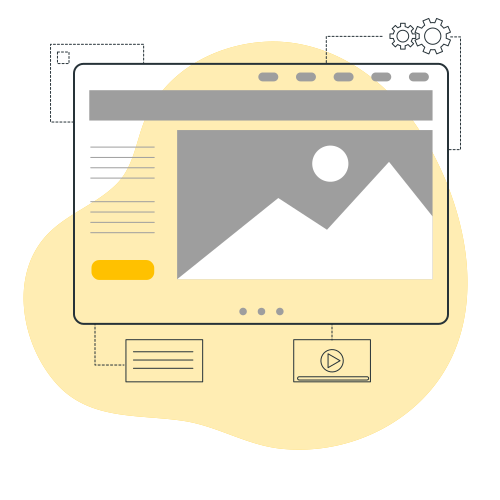
If you're rewriting your homepage today, this is the structure we'd use. For a deeper dive on what every page needs, see our guide on what a small business website should actually include.
- Headline, what you do, for whom, in plain language. Not clever. Clear.
- Sub-headline: the specific benefit or outcome. One line.
- Primary call to action, one button, one clear next step.
- Proof, one or two short testimonials, a logo strip, or a concrete stat.
- Secondary detail, your services, your process, or the questions people ask most.
That's it. Five sections, stacked. Everything else is bonus.
The bottom line
Good website copy isn't about being a clever writer. It's about knowing who you're talking to, saying what matters in plain language, and giving people one clear thing to do next. If you're honest, specific, and brief, you're already ahead of 80% of the sites you're competing with.
If you'd like a second opinion on whether your current copy is pulling its weight, that's one of the first things we look at in a consultation. We'll tell you what's working, what's filler, and what to change first.
Is your website copy actually converting? Let's take a look together. No hard sell, just honest feedback on what's working and what isn't.
Book a ConsultationFAQ
What will you learn in "How to Write Website Copy That Actually Converts"?
Most small business owners spend weeks agonising over how their website looks: the colours, the layout, whether the logo is big enough, and then write the copy in twenty minutes the night before launch.
Why is Write for one person, not everyone important?
Because it directly affects trust, message clarity, and conversion before someone contacts you.
What is the best first step?
Apply one practical change this week, measure the result, and repeat with the next highest-impact improvement.

Categories: General